Search
Radiation Oncology

2025 Laboratory Safety Awards & Innovations Event

Remote Target Loader Station

The UW Medical Cyclotron Facility Target Handling System is comprised of a patent pending target station capable of automatic loading and ejecting of targets, a fully shielded hot cell in lab space outside of the cyclotron vault, and a pneumatic transfer system that shuttles radioactive targets unidirectionally from the station to the hot cell for processing. Prior to this system, targets were manually removed from the beamline and the chemical processing performed in a glove box – a workflow that limited production capacity to activity levels that could be safely handled in this way. The new system allows for significantly higher activity to be produced while lowering the overall exposure to personnel at all points in the production workflow. This advancement to our facility will support phase 2 of multiple, very promising, isotope development initiatives. Support for this upgrade was provided in part by the US Department of Energy Isotope Program, managed by the Office of Science for R&D and Production (DE-SC0019197; DE-SC0013618).

Contributing Members:

  • Bob Smith
  • Yawen Li
  • Marissa Kranz
  • Devin Short
  • Adrienne Lehnert
  • Al Mullen
  • Geoff Avila
  • Zack Lindbloom-Brown
  • Don Hamlin
  • Anster Charles


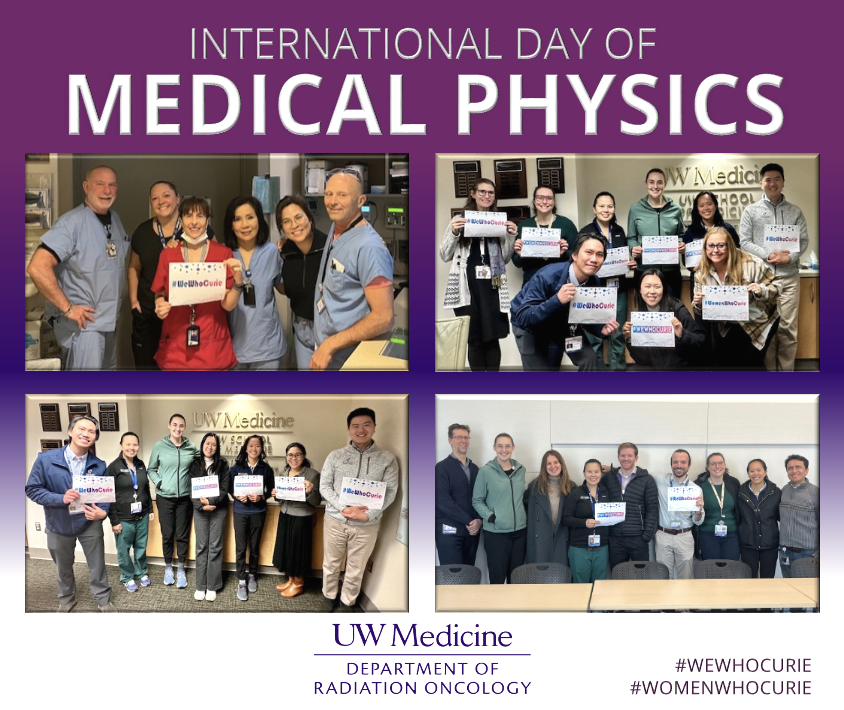
International Day of Medical Physics

UW Radiation Oncology Celebrates International Day of Medical Physics & Madame Curie Day – 2025 

Today we honor Marie Curie, whose pioneering discoveries in radioactivity transformed science and laid the foundation for modern radiation oncology. As the first person to win two Nobel Prizes—in Physics and Chemistry—her legacy continues to inspire generations of scientists and physicians. At #UWRadOnc, we celebrate the contributions of women, and all those who have been traditionally underrepresented in science and medicine, who carry that legacy forward—advancing research, improving patient care, and mentoring the next generation of innovators. Here’s to curiosity, courage, and the pursuit of knowledge! #RadOnc #WomenWhoCurie #WeWhoCurie #UWRadOnc #UWMedicine #FredHutch #MedPhys


Top Doctors 2025 – Radiation Oncology

Education


Congratulations Top Doctors 2025

Seattle Magazine has published their names list for this year’s Top Doctors in Radiation Oncology. Among the list are 12 Radiation Oncologists from UW Medicine.

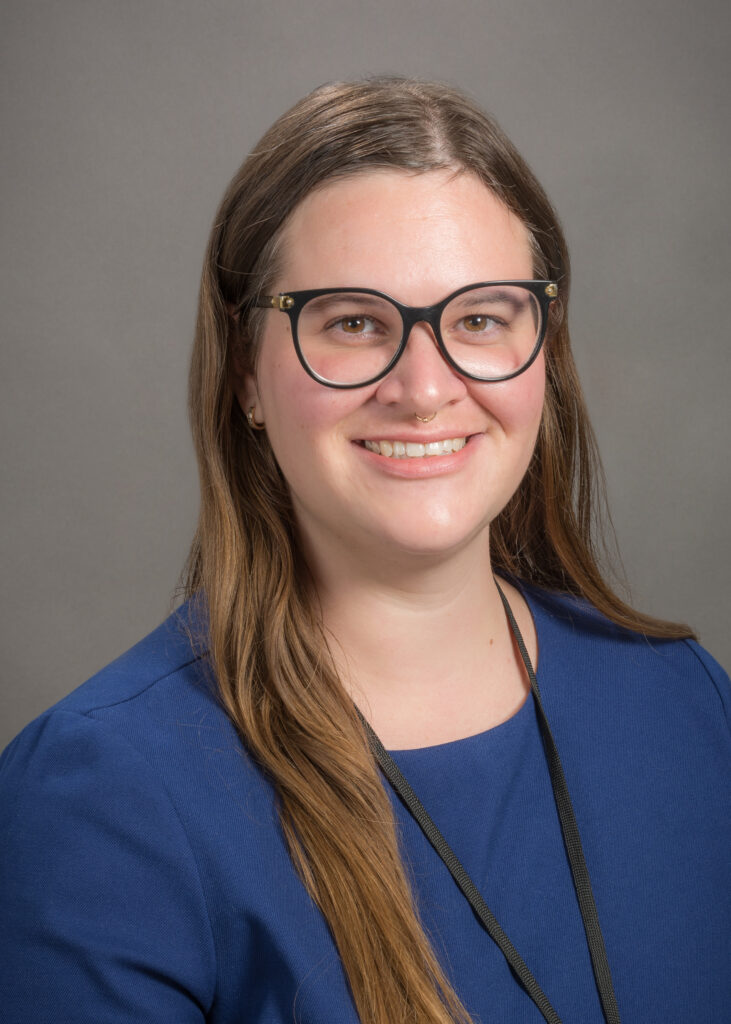
Dr. Fre’Etta Brooks, Ph.D., travels to Nigeria to present research on evaluating global clinical trial credentialing and PSQA systems quantifying the differences among international dosimetry auditing methodologies 

Dr. Brooks approached Professors Hendrickson and Fagerstrom about attending the Nigerian Association of Medical Physicists (NAMP) conference during the second month of her Medical Physics residency.  They encouraged her to submit current research to present so she could broaden her network, and they wanted to support her passion for standardizing radiotherapy quality assurance practices, global oncology, and educational outreach.   

She was invited to give two oral presentations about reference plan development and validation and dosimetry audit assessment and comparison.  Following the conference, she was invited to serve as a board member on a panel dedicated to promoting innovative research for graduate-level medical physicists. Her travel was funded through the Alexander Rodney Muir Endowment  fund.

Presentation Summaries:

A validated framework for developing reference plans: Evaluating global clinical trial credentialing and PSQA systems

This study presented a practical framework to develop and validate a set of reference plans and perturbations that can be used to assess and compare the differentiability of various audit and PQSA methodologies. The Global Quality Assurance of Radiation Therapy Clinical Trials Harmonization Group (GHG) has developed this framework as part of their ongoing work to test the comparability of their audit systems; this framework supports their work of aligning international dosimetry audits across the globe.

PI and co-PI: Stephen F. Kry, Ph.D., University of Texas MD Anderson Cancer Center; Joerg Lehman, Ph.D., Calvary Mater Newcastle Hospital, AUS.

Investigators: Fre’Etta M.D. Brooks, Ph.D. UW Medical Physics resident; Mohammad Hussein, Jessica Lye, Christopher L. Nelson, Nakamura Mitsuhiro, Mallory C. Glenn, Patricia Diez, Rushil Patel, Maddison Shaw, Ileana Silvestre Patallo, Miriam Barry, Catharine H. Clark.


A multi-institutional approach to quantifying the differences among international dosimetry auditing methodologies

This study assessed and compared the performance of end-to-end audits currently offered by six international clinical trial dosimetry audit agencies with the goal of harmonizing audits and reducing overlap in multinational trials while maintaining quality. This effort was led by the GHG.

In general, the agreement demonstrated amongst the auditing methodologies, particularly system sensitivity to detecting errors, suggests that reciprocity of clinical trial credentialing processes could be adopted by these varied agencies. This would streamline the clinical trial process and decrease the number of barriers to clinical trial participation.

PI and co-PI: Stephen F. Kry, Ph.D., University of Texas MD Anderson Cancer Center; Catharine H. Clark, Ph.D., National Physical Laboratory, UK.

Investigators: Fre’Etta M.D. Brooks, Ph.D. UW Medical Physics resident; Joerg Lehmann, Mohammad Hussein, Jessica Lye, Christopher L. Nelson, Mitsuhiro Nakamura, Patricia Diez, Rushil Patel, Peter Greer, Hideaki Hirashima, Julianne M. Pollard Larkin, Rebecca M. Howell, Christine B. Peterson.

Professional Photograph of August Anderson

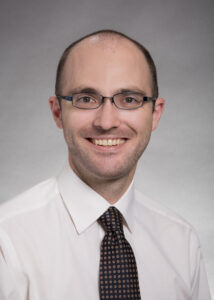
Dr. Samantha Van Nest, Ph.D., initiates and receives funding for a novel research project related to Early Immunogenic Signaling Initiated by Proton FLASH.

Dr. Van Nest (“Sam”) approached Professors Stewart and Sandison on a project of special interest to her a few months into her Medical Physics residency. We worked with her to build a multi-disciplinary team so she could pursue her passion for translational research at the intersection of physics, radiation biology and clinical advancement.

Her project was funded through a prestigious 2024-2025 grant from the Aldarra Foundation. She has been the driving force and inspiration for all aspects of the project; she has taken on a leadership role in the effort to train radiation biology staff on new procedures and is an effective collaborator with all members of our team.

Project Summary

Radiation therapy (RT) has been shown to increase tumor immunogenicity, supporting synergy between RT and immunotherapy. We propose that the therapeutic ratio of proton FLASH RT could be further improved beyond reported studies in the literature of normal tissue sparing by capitalizing on RT induced anti-tumor immunity. This would lead to enhanced tumor-cell targeting by the immune system and support combinations of FLASH RT and immunotherapy. We propose to investigate the role of FLASH RT to modulate key immunogenic and immune suppressive markers in tumors and normal tissue. We will investigate in vitro the extent to which FLASH RT influences antigen processing and presentation, micronuclei formation and rupture, and type-I interferon signaling in breast cancer and normal breast cell lines. This work has the potential to establish fundamental evidence that FLASH RT leads to immunogenic signaling in tumors, or alters signaling in healthy cells, which could be exploited to improve the care of breast patients with radiation-resistant disease through a combination of FLASH RT and immunotherapeutics.


PI and co-PI:

Emily Hatch, Ph.D., Assistant Professor, Basic Sciences and Human Biology, Fred Hutch Cancer Center. Robert D Stewart, Ph.D., Professor of Radiation Oncology and Medical Physicist at the University of Washington (UW).


Co-Investigators: Samantha Van Nest, Ph.D. UW Medical Physics resident

Dani Johnson Erickson, Ph.D., Director, UW Radiation Biology Laboratory; Marissa Kranz, M.S, Director of the UW MCF; George A Sandison, Ph.D., Professor of UW Radiation Oncology and Medical Physics; Keith Stantz, Ph.D. Associate Professor in the School of Health Sciences at Purdue University; Ning Cao, Ph.D. Associate Professor of UW Radiation Oncology; Sunan Cui, Ph.D. Assistant Professor of UW Radiation Oncology